
Moviegoer Value
Over 70% of moviegoers in a loyalty programme churn due to lack of communication — but movie marketers had no easy way to identify who was at risk before it was too late. Moviegoer Value gave marketers the ability to break down their audience by likelihood to churn, so they could act before losing them.
I led the redesign of two existing features called Audience Insights and Movie Insights to deliver this capability, working alongside a researcher who handled interviews and testing.
Interviewing users
We interviewed 5 users on how valuable they would find the ability to break down their target audience further based on a moviegoer’s likelihood to churn. Users expressed strong interest as churn is an important metric to measure and identify to increase revenue and retain moviegoers.
To calculate churn, we utilised the RFM model to calculate a moviegoer’s likelihood to churn based on how recently they attended a cinema, how frequently they attend and how much they spend on average at the cinema.
Userflows for Movie Insights and Audience Insights
Audience Insights and Movie Insights already had established interaction models that users were familiar with. Rather than rebuilding from scratch, I reviewed both existing flows to identify the right place to introduce the RFM churn data without adding unnecessary complexity or disrupting familiar patterns.
I also identified edge cases in the existing flows that we needed to consider before we could add in the new functionality.


Ideation and User Testing
I facilitated multiple co-design sessions with my team of engineers, data scientists and a product manager to help generate ideas for the design. I then started to use the strongest ideas as a starting point to build different prototypes for testing.
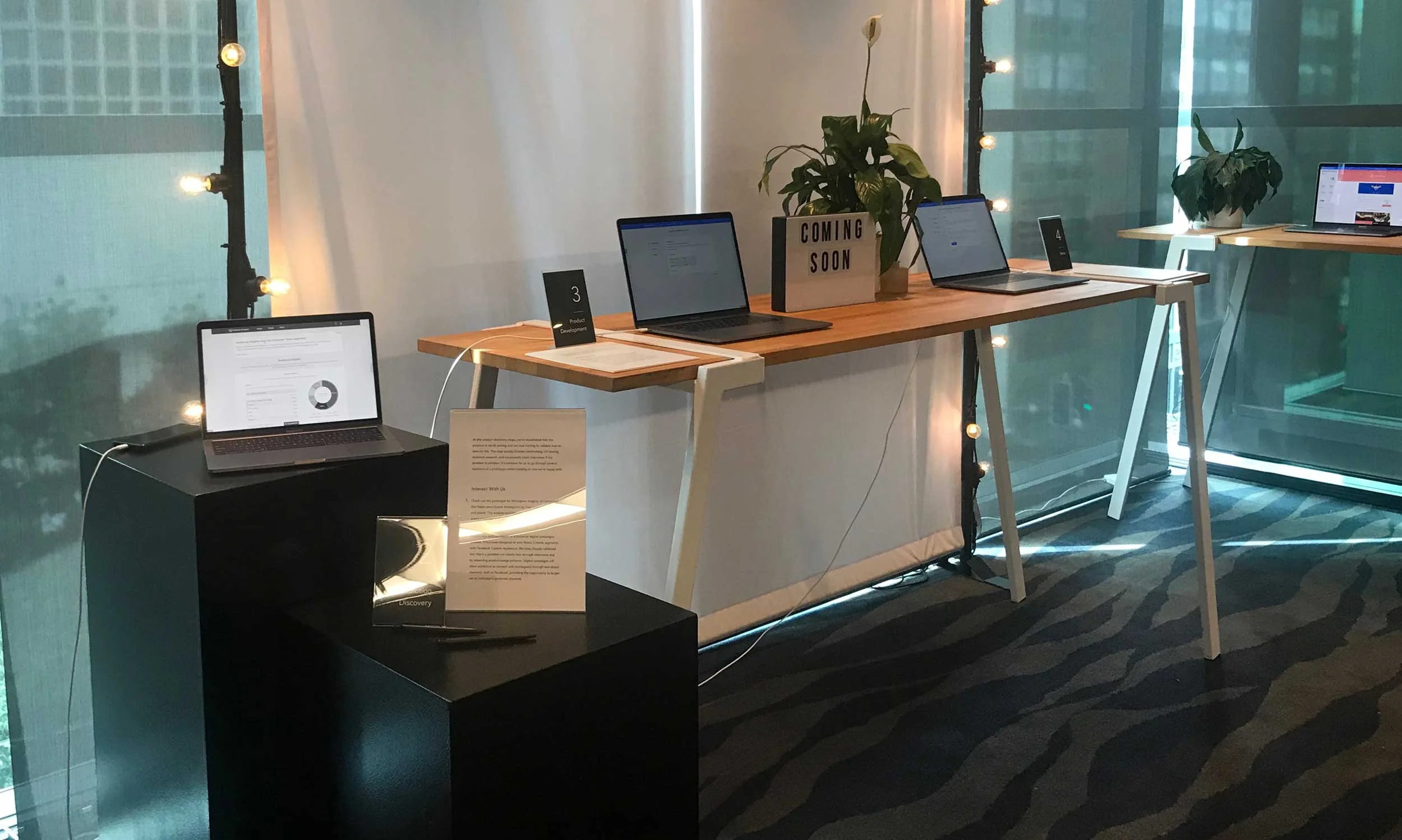
We then ran multiple remote testing sessions and tested with users at our company’s annual conference called Vistacon.
Key findings included:
Users wanted to focus on targeting their most active moviegoers in their program to retain - they rarely target moviegoers who are not as active
Most participants liked the idea of being able to skip the compulsory step of breaking their target audience down further in the Group Builder feature and being able to go straight into a campaign
Some users had an idea of what the churn groups were and what each group means, but still required some additional information in the design to confirm their assumptions
Users wanted to eventually see the improvements achieved over time in Movio’s reporting feature
“ Having the preset segmentation makes it easy to quickly see which customers are in danger of falling off. The information received from the Moviegoer Value Segments table covered everything I was interested in. ” - Customer feedback from our beta program.


Final UI
For the final UI, I updated visual styles and micro-animations to align with the Movio design system, removing legacy components that were distracting users from core tasks. Key design decisions from testing and internal feedback included:
Letting users skip the Group Builder step to go straight into creating a campaign — participants consistently wanted to move faster through the flow
Adding tooltips to each churn group label — participants were consistently confused about what each group meant without context close by
Including additional filters to allow users to quickly select their desired segments to target in the RFM section and save time from manually choosing
Introducing a fade in animation when users load the page to reduce overloading them with multiple items at once when they come to each feature
Audience Insights UI


Movie Insights UI


Design feedback sessions


UI Animation
Managing a complex Information Architecture
The biggest challenge on this project was organizing the information architecture. As the original two features Movie Insights and Audience Insights had a lot of complex actions already, adding more functionality could negatively increase workload.
I solved this challenge by collaborating with different stakeholders to identify what could be removed or hidden from this experience without compromising usability.
My key findings that helped refine my design included:
Allowing users to exclude inactive moviegoers from audience targeting — testing showed participants rarely targeted them, so making this the default saved unnecessary steps
From past user interviews and testing, users mentioned not needing to see subscription categories as they provided little value. I decided to make this information more hidden to avoid presenting too much at once
Internal business stakeholders shared a common pattern that campaigns always started with refining their audience by movie choice first. I adjusted the UI to be clearer that organising by movies should be the first thing to do
Outcome
Moviegoer Value was launched to all customers on July 2019 and received positive feedback from users on how easy it is to pick up and that the usability has improved for the better.
“ It can take time to use new modules, but this was quite easy to use and made a lot of common sense ” - Customer quote from NAI UK Cinemas
“ Michael is able to carry user insights into prototypes quickly. He pays attention to details and is able to use interaction models that are visually appropriate. He also can clearly articulate the rationale behind his design decisions. I highly recommend Michael for his work ethic and attitude. He is a true team player, always willing to give his best, and a pleasure to work with. ”- Grace Bariso (Product Manager at Movio)